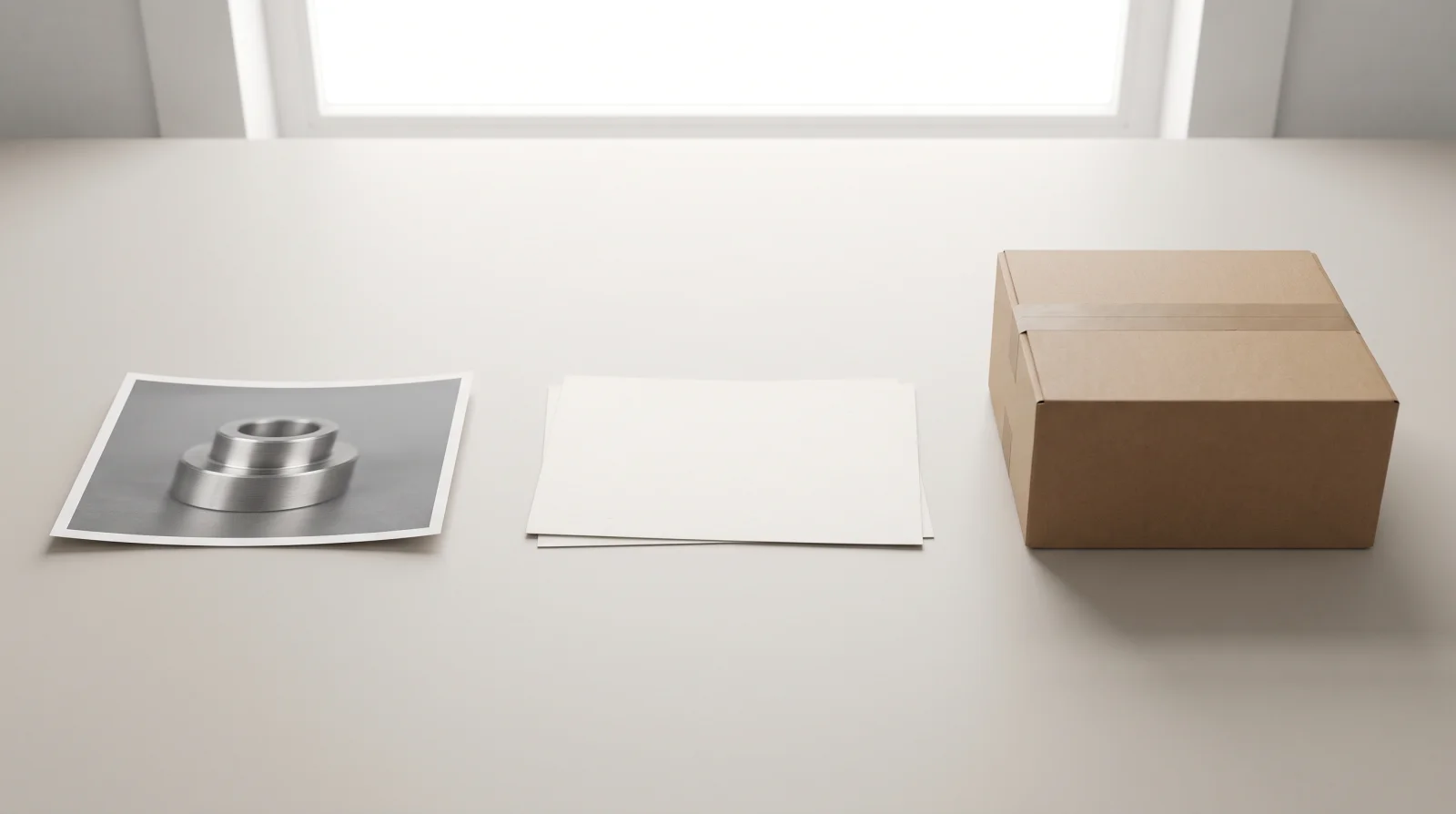
The supplier’s picture looks convincing.
Which item does it represent?La imagen del proveedor convence.
¿Qué artículo representa?L’image du fournisseur est convaincante.
Quel article représente-t-elle ?Yetkazib beruvchining rasmi ishonarli.
Ammo u qaysi buyumni ko‘rsatadi?供应商的产品图很像那么回事
它究竟对应哪件货?
A supplier sends a polished picture of a component. You are preparing the information pack colleagues will use to compare the offer with the requested item. Before copying the picture beside the offer, what connects the two? An image-origin signal may tell you something about how the picture was made. It does not, on its own, identify the physical item or variant being offered. The useful next step is a specific question for the supplier-information owner, not a verdict about whether the picture looks real.Un proveedor envía una imagen cuidada de un componente. Usted prepara el expediente con el que sus compañeros compararán la oferta y el artículo solicitado. Antes de colocar la imagen junto a la oferta, ¿qué vincula ambos elementos? Una señal sobre el origen de la imagen puede aportar información sobre cómo se creó. Por sí sola, no identifica el artículo físico ni la variante ofertados. El siguiente paso útil es plantear una pregunta concreta al responsable de la información del proveedor, no decidir si la imagen parece real.Un fournisseur envoie une image soignée d’un composant. Vous préparez le dossier qui permettra à vos collègues de comparer son offre à l’article demandé. Avant de placer cette image à côté de l’offre, qu’est-ce qui relie les deux ? Un indice sur l’origine de l’image peut renseigner sur sa création. À lui seul, il n’identifie ni l’article physique ni la variante proposés. La suite utile consiste à poser une question précise au responsable des informations fournisseur, pas à décider si l’image paraît réelle.Yetkazib beruvchi bir detalning sifatli ishlangan rasmini yubordi. Siz hamkasblaringiz taklifni so‘ralgan buyum bilan taqqoslashi uchun ma’lumotlar to‘plamini tayyorlayapsiz. Rasmni taklif yoniga qo‘yishdan oldin savol tug‘iladi: ularni nima bog‘laydi? Rasmning kelib chiqishiga oid belgi uning qanday yaratilgani haqida ma’lumot berishi mumkin. Lekin uning o‘zi taklif etilayotgan jismoniy buyum yoki variantni aniqlamaydi. Foydali keyingi qadam rasm haqiqiydek ko‘rinadimi, deb baho berish emas, yetkazib beruvchi ma’lumotlari uchun mas’ul shaxsga aniq savol berishdir.供应商发来一张制作精良的零部件图片。您正在整理资料,供同事把报价与所需产品进行比较。把图片放到报价旁边之前,先问一句:两者有什么对应依据?图片来源线索或许能说明它是怎么制作的,却不能单独确定所报的实物或具体型号。下一步值得做的,不是判断图片看起来真不真,而是请供应商资料负责人带着一个具体问题去确认。
SynexasPublishedPublicadoPubliéE’lon qilingan发布日期
Keep the picture useful.
Keep its meaning bounded.Aproveche la imagen.
No le atribuya más de lo que acredita.Gardez l’image utile.
Sans lui faire dire davantage.Rasmdan foydalaning.
Unga ortiqcha ma’no yuklamang.图片可以帮助理解
但别让它替文件作证
Evaluation scopeAlcance de la evaluaciónPérimètre de l’évaluationBaholash doirasi评估范围
Distinguish what the image shows from what the supplier says it represents. A picture beside an offer is not itself a documented connection.Distinga lo que se ve de lo que el proveedor dice que representa. Colocar una imagen junto a una oferta no documenta por sí solo esa relación.Distinguez ce que l’image montre de ce que le fournisseur dit qu’elle représente. Sa présence à côté d’une offre ne documente pas ce lien.Rasmda nima ko‘rinayotgani bilan yetkazib beruvchi uni nimaning tasviri deb ko‘rsatayotganini ajrating. Rasmning taklif yonida turishi ular o‘rtasidagi bog‘liqlik hujjatda ko‘rsatilganini anglatmaydi.分清图片里看见了什么,以及供应商说它代表什么。图片放在报价旁边,本身不构成书面的对应依据。
Comparable evidenceEvidencia comparableÉléments de preuve comparablesTaqqoslanadigan dalillar可比证据
Provenance means information about origin or history. Available signals can inform that question without establishing the offered item.La procedencia es la información sobre el origen o el historial de un contenido. Las señales disponibles pueden ayudar a conocerla sin identificar el artículo ofertado.La provenance désigne les informations sur l’origine ou l’historique d’un contenu. Les indices disponibles peuvent éclairer cette question sans identifier l’article proposé.Kelib chiqish tarixi deganda materialning qayerdan kelgani yoki qanday o‘zgargani haqidagi ma’lumot tushuniladi. Mavjud belgilar shu savolni yoritishi mumkin, ammo taklifdagi buyumni aniqlamaydi.“来源与沿革信息”指内容从哪里来、经历过什么。现有标记可以帮助了解这些情况,却不能确定供应商所报的产品。
Review ownershipResponsabilidad de la revisiónResponsabilité de la revueKo‘rib chiqish uchun mas’uliyat审查责任归属
The supplier-information owner seeks and preserves the supplier’s explanation. Authorized colleagues retain conformity, inspection, safety and acceptance decisions.El responsable de la información del proveedor solicita y conserva su explicación. Las decisiones de conformidad, inspección, seguridad y aceptación siguen correspondiendo a las personas autorizadas.Le responsable des informations fournisseur demande et conserve l’explication du fournisseur. Les décisions de conformité, d’inspection, de sécurité et d’acceptation restent aux personnes habilitées.Yetkazib beruvchi ma’lumotlari uchun mas’ul shaxs izohni so‘raydi va saqlaydi. Muvofiqlik, ko‘rik, xavfsizlik va qabul qilish qarorlari vakolatli shaxslarda qoladi.供应商资料负责人负责索取并保留供应商的说明。产品符合性、检验、安全和验收仍由有权限的人员判断。
Acceptance decisionDecisión de aceptaciónDécision d’acceptationQabul qilish qarori验收决定
Circulate supported wording and visible gaps. A clarified picture reference is not approval of the product or the purchase.Comparta afirmaciones respaldadas y mantenga visibles las lagunas. Aclarar a qué se refiere una imagen no supone aprobar el producto ni la compra.Diffusez les formulations étayées et laissez les lacunes visibles. Clarifier la référence d’une image ne vaut approbation ni du produit ni de l’achat.Faqat asoslangan ifodalarni ulashing, aniqlanmagan jihatlarni esa ochiq ko‘rsating. Rasm nimaga tegishli ekanini aniqlashtirish mahsulot yoki xaridni tasdiqlash emas.传递有依据的表述,把缺口留在明处。弄清图片对应关系,不等于批准产品或采购。
A picture can explain a shape.
It cannot supply its own reference.Una imagen puede explicar una forma.
No puede acreditar a qué artículo corresponde.Une image peut expliquer une forme.
Pas établir seule sa référence.Rasm shaklni tushuntirishi mumkin.
Qaysi buyumga tegishli ekanini o‘zi tasdiqlamaydi.图片能帮助看懂外形
却不能自行证明对应哪款产品
Consider a generic component pictured in a supplier’s offer. Colleagues may use its shape to understand the discussion. But does the picture represent the offered variant, another variant in the range or an illustration? This is a proposed reading situation, not an examined supplier case. Copying the image into a comparison can conceal that unanswered question. A heading naming the requested item may make the picture appear more specific than the supplier’s material establishes. Keep the original file and its surrounding explanation available; do not silently give it a stronger description.Piense en un componente genérico ilustrado en una oferta. Su forma puede ayudar a los compañeros a seguir la conversación. Pero ¿la imagen representa la variante ofertada, otra variante de la gama o una ilustración? Es una situación de compra que planteamos como ejemplo, no un caso de proveedor que hayamos examinado. Copiarla en una comparación puede ocultar esa pregunta pendiente. Un encabezado con el nombre del artículo solicitado puede hacer que la imagen parezca más específica de lo que acredita la documentación del proveedor. Conserve el archivo original y su explicación; no le atribuya, sin indicarlo, un significado más preciso.Prenons un composant générique illustré dans une offre. Sa forme peut aider vos collègues à comprendre la discussion. Mais l’image représente-t-elle la variante proposée, une autre variante de la gamme ou une illustration ? C’est une situation d’achat que nous proposons comme exemple, pas un dossier fournisseur examiné. Copier l’image dans un comparatif peut masquer cette question sans réponse. Un titre reprenant l’article demandé peut lui donner une portée plus précise que les éléments du fournisseur ne le permettent. Gardez accessibles le fichier original et son explication, sans renforcer discrètement sa description.Taklifda umumiy bir detal tasvirlanganini tasavvur qiling. Uning shakli hamkasblarga muhokamani tushunishda yordam berishi mumkin. Ammo rasm taklifdagi variantnimi, shu turkumdagi boshqa variantnimi yoki shunchaki tasviriy izohnimi ko‘rsatadi? Bu xaridga oid ma’lumotlarni tayyorlashda uchrashi mumkin bo‘lgan vaziyat sifatida keltirildi; biz biror yetkazib beruvchining shunday holatini o‘rganmaganmiz. Rasmni taqqoslash hujjatiga ko‘chirish javobsiz savolni yashirishi mumkin. So‘ralgan buyum nomi yozilgan sarlavha rasmni yetkazib beruvchi materiallari tasdiqlaganidan aniqroq ko‘rsatib qo‘yadi. Asl fayl va unga berilgan izohni saqlang; ma’lumotlarni tayyorlashda rasm aynan nimani ko‘rsatishi haqida asossiz aniqlik kiritmang.设想一份报价里有张通用零件图。同事可以借它了解讨论的对象。但它展示的是本次报价的型号、同系列另一款,还是一张示意图?这是本文提出的阅读情境,并非我们查验过的供应商案例。 把图片复制进对比资料,可能掩盖这个尚未回答的问题。如果上方直接写上所需产品的名称,读者可能以为图片比供应商原始材料所能证明的更具体。请保留原始文件及其前后说明,不要在整理时悄悄强化图片的含义。
Two questions need different support. How was this image created or changed? Which offered item does it represent? Provenance, meaning information about origin or history, can help with the first. The second needs an explicit connection in the supplier’s information. Even an image known to come from a camera would not, by that fact alone, establish the offered variant. Conversely, an illustration can help explain an offer if its role and limits are clear. The problem is unsupported meaning, not simply the presence of AI.Hay dos preguntas que requieren apoyos distintos: ¿cómo se creó o modificó esta imagen?, y ¿qué artículo ofertado representa? La procedencia, es decir, la información sobre el origen o el historial, puede ayudar con la primera. La segunda necesita una conexión explícita en la información del proveedor. Incluso saber que una imagen procede de una cámara no bastaría para identificar la variante ofertada. A la inversa, una ilustración puede ayudar a explicar una oferta si quedan claros su función y sus límites. El problema es atribuirle un significado sin respaldo, no simplemente que intervenga la IA.Deux questions appellent des éléments différents. Comment cette image a-t-elle été créée ou modifiée ? Quel article proposé représente-t-elle ? La provenance, c’est-à-dire les informations sur l’origine ou l’historique, peut aider pour la première. La seconde exige un lien explicite dans les informations du fournisseur. Même savoir qu’une image provient d’un appareil photo ne suffirait pas à établir la variante proposée. À l’inverse, une illustration peut faciliter la compréhension d’une offre si son rôle et ses limites sont clairs. Le problème est le sens attribué sans appui, pas simplement l’emploi de l’IA.Ikki savolga ikki xil asos kerak. Bu rasm qanday yaratilgan yoki o‘zgartirilgan? U taklifdagi qaysi buyumni ko‘rsatadi? Kelib chiqish tarixi, ya’ni materialning manbasi yoki o‘tmishi haqidagi ma’lumot birinchi savolga yordam berishi mumkin. Ikkinchisi uchun yetkazib beruvchi ma’lumotlarida aniq bog‘liqlik bo‘lishi kerak. Rasm kamera bilan olingani ma’lum bo‘lsa ham, buning o‘zi taklifdagi variantni tasdiqlamaydi. Aksincha, vazifasi va chegaralari tushunarli bo‘lgan tasviriy rasm taklifni izohlashga yordam berishi mumkin. Muammo faqat AI ishlatilganida emas, rasmga asossiz ma’no berilishida.这里有两个问题,需要不同的依据:图片是怎样生成或修改的?它代表本次报价中的哪件产品?来源与沿革信息,也就是内容的起源和历史,可以帮助回答前一个问题。后一个问题则需要供应商资料明确建立对应关系。 即使已知图片由相机拍摄,也不能仅凭这一点确定报价型号。反过来,只要用途和限制说清楚,示意图同样可以帮助理解报价。问题不只是有没有使用 AI,而是图片是否被赋予了没有依据的含义。
Read the origin signal.
Then return to the offered item.Lea la señal sobre el origen.
Después, vuelva al artículo ofertado.Lisez l’indice d’origine.
Puis revenez à l’article proposé.Kelib chiqish belgisini ko‘rib chiqing.
Keyin taklifdagi buyumga qayting.看清来源线索能说明什么
再回到本次报价的产品
Google DeepMind’s August 29, 2023 launch described a SynthID beta limited to a group of Google Cloud customers using a particular image generator. It embedded an invisible watermark in image pixels. Identification assessed likelihood, with three confidence levels; a detected watermark suggested that part of the image was generated by the covered system. It was not a certainty about every image. The launch attributed robustness against many common edits to internal testing and expressly said extreme manipulation could defeat the approach. It also explained that metadata, information stored with a file, can be removed or lost during editing. Pixel watermarks and metadata are different ways to carry origin information. The current Google overview describes broader coverage across media and image watermarks designed to withstand edits such as cropping, filters and lossy compression. OpenAI’s current guidance says its covered generated images carry Content Credentials and SynthID signals, while qualifying coverage by product, model, export path, file type and creation time, with stated exceptions. These are provider descriptions, not our detector tests. Broader coverage does not transfer historical beta findings to every current tool. Nor does an absent signal establish an unaltered photograph: coverage is conditional and metadata can disappear. Most importantly for this pack, neither provider page supplies the connection to the supplier’s offered item.En su anuncio del 29 de agosto de 2023, Google DeepMind presentó una versión beta de SynthID limitada a un grupo de clientes de Google Cloud que utilizaban un generador de imágenes concreto. Incorporaba una marca de agua invisible en los píxeles. La identificación estimaba una probabilidad con tres niveles de confianza; detectar la marca indicaba que probablemente una parte de la imagen se había generado con el sistema al que se aplicaba esa identificación. No ofrecía certeza sobre cualquier imagen. El anuncio atribuía la resistencia frente a muchas modificaciones habituales a pruebas internas y advertía expresamente de sus límites ante manipulaciones extremas. También explicaba que los metadatos, información almacenada con el archivo, pueden eliminarse o perderse al editarlo. Las marcas en los píxeles y los metadatos son formas distintas de transmitir información sobre el origen. La presentación actual de Google describe su uso en más tipos de contenido y marcas de imagen diseñadas para resistir recortes, filtros y compresión con pérdida. La documentación actual de OpenAI indica que las imágenes generadas que entran en el ámbito que especifica incluyen Content Credentials y señales SynthID. Precisa que la aplicación de estas señales depende del producto, modelo, vía de exportación, tipo de archivo y momento de creación, con excepciones expresas. Son descripciones de los proveedores, no pruebas nuestras de detección. Que estas señales se apliquen a más tipos de contenido no extiende los resultados de aquella beta a todas las herramientas actuales. Tampoco la ausencia de señal acredita una fotografía sin modificar: las señales no se aplican en todos los casos y los metadatos pueden desaparecer. Sobre todo, ninguna de estas páginas conecta la imagen con el artículo que ofrece el proveedor.Dans son annonce du 29 août 2023, Google DeepMind présentait une version bêta de SynthID réservée à un groupe limité de clients Google Cloud utilisant un générateur d’images particulier. Un filigrane invisible était intégré aux pixels. L’identification estimait une probabilité selon trois niveaux de confiance ; sa détection indiquait qu’une partie de l’image avait probablement été produite par le système auquel cette identification s’appliquait. Ce n’était pas une certitude applicable à toute image. L’annonce attribuait la résistance à de nombreuses modifications courantes à des tests internes et précisait les limites face aux manipulations extrêmes. Elle expliquait aussi que les métadonnées, informations conservées avec le fichier, peuvent être supprimées ou perdues lors d’une modification. Filigranes dans les pixels et métadonnées sont deux façons distinctes de porter des informations d’origine. La présentation actuelle de Google décrit une utilisation étendue à plusieurs médias et des filigranes d’image conçus pour résister notamment au recadrage, aux filtres et à la compression avec perte. La documentation actuelle d’OpenAI indique que les images générées entrant dans le périmètre qu’elle précise comportent Content Credentials et des signaux SynthID. Elle ajoute que l’application de ces signaux varie selon le produit, le modèle, le mode d’exportation, le type de fichier et la date de création, avec des exceptions explicites. Ce sont les descriptions des fournisseurs, pas nos propres tests de détection. L’extension de ces signaux à davantage de contenus n’étend pas les résultats de l’ancienne bêta à tous les outils actuels. L’absence de signal n’établit pas non plus qu’il s’agit d’une photographie non modifiée : ces signaux ne s’appliquent pas à tous les cas et les métadonnées peuvent disparaître. Surtout, aucune des deux pages ne relie l’image à l’article proposé par votre fournisseur.Google DeepMind 2023-yil 29-avgustdagi e’lonida SynthID beta versiyasi ma’lum bir rasm yaratish vositasidan foydalangan cheklangan Google Cloud mijozlari guruhiga berilganini yozgan. U rasm piksellariga ko‘rinmas suv belgisini joylagan. Aniqlash uchta ishonch darajasi bilan ehtimolni baholagan; belgi topilishi rasmning bir qismi aynan shu belgi qo‘llanadigan tizimda yaratilgan bo‘lishi mumkinligini ko‘rsatgan. Bu har qanday rasm uchun qat’iy xulosa emas edi. E’londa ko‘plab odatiy tahrirlarga chidamlilik ichki sinovlarga asoslangani aytilgan va keskin o‘zgartirishlar usulni chetlab o‘tishi mumkinligi ochiq qayd etilgan. Unda fayl bilan saqlanadigan ma’lumotlar, ya’ni metadata, o‘chirib tashlanishi yoki tahrir paytida yo‘qolishi mumkinligi ham tushuntirilgan. Pikseldagi suv belgilari va metadata kelib chiqish ma’lumotlarini saqlashning alohida usullaridir. Google’ning joriy sharhida bu usul endi ko‘proq turdagi materiallarga qo‘llanishi hamda rasm belgilari qirqish, filtr va yo‘qotishli siqish kabi tahrirlarga chidash uchun yaratilgani tasvirlanadi. OpenAI’ning joriy qo‘llanmasida o‘zi belgilagan doiraga kiradigan yaratilgan rasmlarda Content Credentials va SynthID belgilari bo‘lishi aytiladi. Biroq bu belgilarning qo‘llanishi mahsulot, model, eksport yo‘li, fayl turi va yaratilgan vaqtga bog‘liq, aniq istisnolar ham bor. Bular provayderlarning bayonotlari, biz o‘tkazgan aniqlash sinovlari emas. Belgilar ko‘proq turdagi materiallarga qo‘llanayotgani eski beta natijalari barcha joriy vositalarga tegishli degani emas. Belgi yo‘qligi ham rasm o‘zgartirilmagan fotosurat ekanini isbotlamaydi: belgilar hamma holatda ham qo‘llanmaydi, metadata esa yo‘qolishi mumkin. Eng muhimi, bu sahifalarning hech biri rasmni yetkazib beruvchi taklif qilayotgan buyumga bog‘lamaydi.Google DeepMind 在 2023 年 8 月 29 日的发布文章中介绍了 SynthID 测试版。当时它只面向一小部分使用特定图像生成工具的 Google Cloud 客户,在图片像素中嵌入不可见水印。识别结果以三个置信等级表达可能性;检测到水印,意味着图片的一部分可能由所覆盖的系统生成,并非对所有图片都能下确定结论。 文章把对多种常见编辑的耐受性归于内部测试,同时明确指出,极端处理可能使这种方法失效。它也说明,随文件保存的元数据可能被手动删除,或在编辑时丢失。像素水印与元数据,是承载来源信息的两种不同方式。 Google 当前的介绍已覆盖更多媒体类型,并称图片水印在设计上可耐受裁剪、滤镜和有损压缩等处理。OpenAI 当前的说明称,其覆盖范围内的生成图片带有 Content Credentials 和 SynthID 标记;但覆盖情况取决于产品、模型、导出路径、文件类型和生成时间,并列有例外。 这些是提供商的说明,不是我们进行的检测实验。覆盖范围扩大,不代表历史测试版的结果适用于今天所有工具。没有发现标记,也不能据此认定图片是未经修改的照片:覆盖有条件,元数据也可能消失。对这份资料最重要的是,两家提供商的页面都没有建立图片与供应商所报产品之间的关系。
Proposed reading sequence: picture to supplier question
- Locate the picture
- Read origin information
- Find the missing item link
- Ask the information owner
Keep the original picture and its place in the offer available.
Provider-described signals concern covered image origins. Missing signals do not prove an unaltered photograph.
Neither appearance nor an origin signal identifies the offered item or variant. Locate the supplier’s explicit connection.
Ask which item the picture represents and where that is recorded. Proposed reading order only; conformity, inspection, safety and acceptance stay with authorized people.
Secuencia de lectura propuesta: de la imagen a la pregunta
- Localice la imagen
- Lea la información de origen
- Identifique el vínculo que falta
- Consulte al responsable
Conserve la imagen original y su ubicación en la oferta.
Las señales descritas por los proveedores informan del origen de las imágenes a las que se aplican. Su ausencia no acredita una fotografía sin modificar.
Ni la apariencia ni una señal de origen identifican el artículo o la variante ofertados. Busque la conexión explícita del proveedor.
Pregunte qué artículo representa y dónde consta. Solo se propone un orden de lectura; conformidad, inspección, seguridad y aceptación corresponden a personas autorizadas.
Lecture proposée : de l’image à la question au fournisseur
- Retrouvez l’image
- Lisez les informations d’origine
- Repérez le lien manquant
- Interrogez le responsable
Gardez accessibles l’image originale et son emplacement dans l’offre.
Les signaux décrits par les fournisseurs renseignent sur l’origine des images auxquelles ils s’appliquent. Leur absence ne prouve pas une photographie non modifiée.
Ni l’apparence ni un indice d’origine n’identifient l’article ou la variante proposés. Cherchez le lien explicite fourni par le fournisseur.
Demandez quel article est représenté et où cela est consigné. Simple ordre de lecture proposé ; conformité, inspection, sécurité et acceptation restent aux personnes habilitées.
Ma’lumotlarni ko‘rib chiqish uchun taklif: rasmdan aniq savolga
- Rasmni toping
- Kelib chiqish ma’lumotini ko‘rib chiqing
- Yetishmayotgan bog‘liqlikni toping
- Ma’lumotlar uchun mas’ul shaxsdan so‘rang
Asl rasmni va uning taklifdagi joyini saqlang.
Provayder ta’riflagan belgilar faqat ular qo‘llanadigan rasmlarning kelib chiqishini bildiradi. Belgi yo‘qligi o‘zgartirilmagan fotosuratni isbotlamaydi.
Ko‘rinish ham, kelib chiqish belgisi ham taklifdagi buyum yoki variantni aniqlamaydi. Yetkazib beruvchining ular o‘rtasidagi bog‘liqlikni aniq ko‘rsatgan izohini toping.
Qaysi buyum ko‘rsatilgani va bu qayerda qayd etilganini so‘rang. Bu faqat ma’lumotlarni ko‘rib chiqish uchun taklif; muvofiqlik, ko‘rik, xavfsizlik va qabul qilish vakolatli shaxslarda qoladi.
建议的阅读顺序:从产品图走到具体确认问题
- 找到原图
- 阅读来源信息
- 找出对应缺口
- 请资料负责人确认
保留原始图片,以及它在报价材料中的位置。
提供商描述的标记只涉及覆盖范围内的图片来源。没有标记,不证明是未经修改的照片。
外观和来源标记都不能确定报价产品或型号。查找供应商明确写出的对应依据。
询问图片代表哪件产品、对应依据写在哪里。这只是建议的阅读顺序;产品符合性、检验、安全和验收仍由有权限的人员负责。
Ask what the picture represents.
Ask where that connection is recorded.Pregunte qué representa la imagen.
Y dónde consta esa relación.Demandez ce que représente l’image.
Et où ce lien est consigné.Rasm nimani ko‘rsatishini so‘rang.
Bu bog‘liqlik qayerda qayd etilganini aniqlang.问清图片代表什么
再问对应依据写在哪里
Give the supplier-information owner the picture, its original location and the offer entry beside which it would appear. Ask: which offered item and variant does this picture represent? Is it intended to show that item, another version or an illustration? Where does the supplier record the connection? A useful clarification might point to an existing offer attachment or provide a written explanation identifying the relevant item reference and picture. These are possible questions and responses, not documents the sources require or evidence we have inspected. If the reply merely repeats that the picture is genuine, the item question remains unanswered. Ask what visible differences colleagues should not read as offered features. Where the explanation conflicts with another attachment, return that specific conflict to the owner rather than choosing the more persuasive picture.Entregue al responsable de la información del proveedor la imagen, su ubicación original y la entrada de la oferta junto a la que aparecería. Pregunte: ¿qué artículo y variante ofertados representa? ¿Pretende mostrar ese artículo, otra versión o una ilustración? ¿Dónde documenta el proveedor esa relación? Una aclaración útil podría remitir a un anexo existente o aportar una explicación escrita que identifique la referencia del artículo y la imagen. Son posibles preguntas y respuestas, no documentos exigidos por las fuentes ni pruebas que hayamos inspeccionado. Si la respuesta se limita a repetir que la imagen es auténtica, sigue sin resolver la pregunta sobre el artículo. Pregunte qué diferencias visibles no deben interpretarse como características ofertadas. Si la explicación contradice otro anexo, devuelva ese conflicto concreto al responsable en lugar de escoger la imagen más convincente.Transmettez au responsable des informations fournisseur l’image, son emplacement d’origine et la ligne de l’offre à côté de laquelle elle figurerait. Demandez : quel article et quelle variante proposés représente-t-elle ? Est-elle censée montrer cet article, une autre version ou une illustration ? Où le fournisseur consigne-t-il ce lien ? Une clarification utile pourrait renvoyer à une annexe existante ou fournir une explication écrite identifiant la référence de l’article et l’image. Ce sont des questions et réponses possibles, non des documents exigés par les sources ou des pièces que nous aurions inspectées. Si la réponse répète seulement que l’image est authentique, la question de l’article reste ouverte. Demandez quelles différences visibles ne doivent pas être interprétées comme des caractéristiques proposées. Si l’explication contredit une autre annexe, renvoyez ce conflit précis au responsable plutôt que de retenir l’image la plus persuasive.Yetkazib beruvchi ma’lumotlari uchun mas’ul shaxsga rasmni, uning asl joylashuvini va taklifning qaysi bandi yonida turishini ko‘rsating. So‘rang: bu rasm taklifdagi qaysi buyum va variantni ifodalaydi? Aynan shu buyumni, boshqa versiyani yoki tasviriy izohni ko‘rsatish uchunmi? Yetkazib beruvchi bu bog‘liqlikni qayerda qayd etgan? Foydali javob mavjud ilovaga yo‘naltirishi yoki taklifdagi buyum yoxud variantni ajratib ko‘rsatadigan ma’lumotlar va unga tegishli rasm aniq qayd etilgan yozma izoh bo‘lishi mumkin. Bular mumkin bo‘lgan savol va javoblar, manbalar talab qilgan hujjatlar yoki biz ko‘rgan dalillar emas. Javob faqat rasm haqiqiyligini takrorlasa, buyum haqidagi savol ochiq qoladi. Ko‘rinadigan qaysi farqlarni taklif etilgan xususiyat deb tushunmaslik kerakligini so‘rang. Izoh boshqa ilovaga zid bo‘lsa, ishonarliroq rasmni tanlash o‘rniga aynan shu ziddiyatni mas’ul shaxsga qaytaring.把图片、它在原始材料中的位置,以及准备与它并列的报价条目交给供应商资料负责人。请其确认:图片代表本次报价中的哪件产品、哪个型号?它是要展示这一款、另一版本,还是仅作示意?供应商在哪里写明了这种对应关系? 有用的澄清可能是指向现有报价附件,也可能是一份注明产品编号与对应图片的书面说明。这些只是可能的问法和答复形式,并非来源要求的文件,也不是我们查验过的证据。如果答复只是重复“图片是真的”,产品对应问题仍然没有解决。 还可以问:图片中哪些可见差异,不应被理解为本次提供的特征?如果说明与另一份附件冲突,应把这个具体矛盾交回负责人处理,而不是选择看起来更有说服力的图片。
Prepare a clearer pack.
Do not approve the physical item.Prepare un expediente más claro.
No apruebe con ello el artículo físico.Préparez un dossier plus clair.
Sans approuver l’article physique.Ma’lumotlar to‘plamini aniqlashtiring.
Jismoniy buyumni tasdiqlamang.把资料整理得更清楚
不等于批准这件实物
We propose retaining the original picture reference, the offered item reference, the supplier’s explanation, available origin information and any unresolved connection in a short reading note. This is our analysis, not a measured procurement method or a provider-prescribed acceptance procedure. Before circulation, compare the pack’s wording with that explanation. If it supports only a general illustration, say so rather than naming a particular variant beneath it. If the connection remains unresolved, keep that question beside the image and identify who will pursue it. A missing reply is not confirmation. The supplier-information owner can prepare a better documentary handoff without judging whether the item conforms to requirements. Product conformity, physical inspection, safety and acceptance remain with authorized people under existing procedures. Even a well-documented picture-to-item connection does not establish availability, condition or suitability, and it does not authorize a purchase.Proponemos conservar en una breve nota la referencia de la imagen original, la del artículo ofertado, la explicación del proveedor, la información disponible sobre el origen y cualquier vínculo aún sin aclarar. Es nuestro análisis, no un método de compras con eficacia medida ni un procedimiento de aceptación prescrito por los proveedores tecnológicos. Antes de distribuir el expediente, contraste su redacción con esa explicación. Si solo respalda el uso como ilustración general, indíquelo en vez de identificar una variante concreta debajo. Si la relación sigue sin resolverse, mantenga la pregunta junto a la imagen e identifique quién la seguirá. La falta de respuesta no equivale a confirmación. El responsable de la información del proveedor puede entregar a sus compañeros una documentación más clara sin decidir si el artículo cumple los requisitos. La conformidad del producto, la inspección física, la seguridad y la aceptación corresponden a las personas autorizadas según los procedimientos existentes. Incluso una relación bien documentada entre imagen y artículo no acredita disponibilidad, estado o idoneidad, ni autoriza una compra.Nous proposons de conserver dans une courte note la référence de l’image originale, celle de l’article proposé, l’explication du fournisseur, les informations d’origine disponibles et tout lien restant à établir. C’est notre analyse, pas une méthode d’achat à l’efficacité mesurée ni une procédure d’acceptation prescrite par les fournisseurs technologiques. Avant diffusion, comparez les formulations du dossier à cette explication. Si elle n’étaye qu’une illustration générale, dites-le plutôt que de nommer une variante précise sous l’image. Si le lien reste incertain, gardez la question à proximité et indiquez qui la suivra. Une absence de réponse ne vaut pas confirmation. Le responsable des informations fournisseur peut transmettre à ses collègues des pièces et des explications plus claires sans juger la conformité de l’article aux exigences. Conformité du produit, inspection physique, sécurité et acceptation restent du ressort des personnes habilitées, selon les procédures existantes. Même un lien image-article bien documenté n’établit ni la disponibilité, ni l’état, ni l’adéquation du produit et n’autorise pas un achat.Qisqa izohda asl rasmni qayerdan topish mumkinligini, taklifdagi buyum yoki variantni ajratib ko‘rsatadigan ma’lumotlarni, yetkazib beruvchining tushuntirishini, rasmning kelib chiqishiga oid mavjud ma’lumotlarni va hali aniqlanmagan bog‘liqlikni qayd etishni taklif qilamiz. Bu bizning tahlilimiz, samarasi o‘lchangan xarid usuli yoki provayder belgilagan qabul qilish tartibi emas. Tarqatishdan oldin to‘plamdagi jumlalarni shu tushuntirish bilan solishtiring. U faqat umumiy tasviriy rasm ekanini asoslay olsa, tagiga aniq variant nomini yozish o‘rniga shuni ayting. Bog‘liqlik hal qilinmagan bo‘lsa, savolni rasm yonida qoldiring va kim javob izlashini ko‘rsating. Javob kelmagani tasdiq emas. Yetkazib beruvchi ma’lumotlari uchun mas’ul shaxs buyum talablarga mosligini baholamasdan ham hamkasblariga tegishli hujjatlar va tushuntirishlarni aniqroq taqdim etishi mumkin. Mahsulot muvofiqligi, jismoniy ko‘rik, xavfsizlik va qabul qilish amaldagi tartiblar bo‘yicha vakolatli shaxslarda qoladi. Rasm va buyum o‘rtasidagi yaxshi hujjatlashtirilgan bog‘liqlik ham mavjudlik, holat yoki yaroqlilikni tasdiqlamaydi va xaridga ruxsat bermaydi.我们建议用一份简短阅读记录保留原始图片引用、报价产品引用、供应商的说明、现有来源信息,以及尚未解决的对应问题。这是本文的分析建议,不是经过效果测量的采购方法,也不是提供商规定的验收程序。 分发前,把资料中的表述与供应商说明逐一对照。如果依据只支持把图片作为通用示意,就如实写明,不要在图下直接标成某个具体型号。对应关系还不清楚,就把问题留在图片旁,并注明由谁继续确认。没有回复,不等于已经确认。 供应商资料负责人可以把文件交接做得更清楚,但不因此判断产品是否满足要求。产品符合性、实物检验、安全和验收仍按现有程序由有权限的人员负责。即便图片与产品的对应关系记录完整,也不能据此证明有货、状态合格或适合使用,更不构成采购授权。
Origin information has a purpose.
It is not item acceptance evidence.La información de origen tiene su función.
No acredita la aceptación del artículo.L’information d’origine a son utilité.
Elle ne vaut pas acceptation de l’article.Kelib chiqish ma’lumotining o‘z vazifasi bor.
U buyumni qabul qilish dalili emas.来源信息有自己的用途
不是产品验收的证明
The 2023 launch is historical; the living Google and OpenAI pages have no established publication or update dates in the returned text. The current pages were compared with the launch, not subjected to an exhaustive correction or retraction search. OpenAI’s returned verification and guidance sections contained headings without substantive instructions, so no checking procedure is inferred from them. No image, detector, supplier document, physical item or workplace outcome was tested or examined. The sources support the distinction about origin signals; the proposed supplier clarification remains an unvalidated reading aid.El lanzamiento de 2023 es histórico; el texto devuelto de las páginas actuales de Google y OpenAI no permite establecer sus fechas de publicación o actualización. Se contrastaron esas páginas con el anuncio, sin una búsqueda exhaustiva de correcciones o retractaciones. Los apartados de verificación y orientación de OpenAI contenían encabezados sin instrucciones sustantivas, por lo que no se deduce de ellos ningún procedimiento. No se examinó ni probó ninguna imagen, detector, documento de proveedor, artículo físico o resultado laboral. Las fuentes respaldan la distinción sobre las señales de origen; las preguntas que proponemos plantear al proveedor son una ayuda para interpretar la documentación, no un método validado.Le lancement de 2023 est historique ; les textes retournés des pages évolutives de Google et d’OpenAI ne permettent pas d’établir leurs dates de publication ou de mise à jour. Ces pages ont été comparées à l’annonce, sans recherche exhaustive de corrections ou de rétractations. Les rubriques de vérification et de conseils d’OpenAI comportaient des titres sans instructions substantielles ; aucune procédure n’en est déduite. Aucune image, aucun détecteur, document fournisseur, article physique ou résultat en entreprise n’a été testé ou examiné. Les sources étayent la distinction concernant les indices d’origine ; les questions que nous proposons de poser au fournisseur restent une aide à la compréhension des pièces, et non une méthode validée.2023-yilgi e’lon tarixiydir; Google va OpenAI’ning yangilanib turuvchi sahifalari bo‘yicha qaytgan matnda nashr yoki yangilanish sanalari aniqlanmadi. Joriy sahifalar ilk e’lon bilan solishtirildi, ammo tuzatishlar yoki qaytarib olishlar bo‘yicha to‘liq qidiruv o‘tkazilmadi. OpenAI’ning tekshirish va tavsiyalar bo‘limlarida mazmunli yo‘riqnomasiz sarlavhalar bor edi; ulardan tekshirish tartibi chiqarilmadi. Hech qanday rasm, aniqlash vositasi, yetkazib beruvchi hujjati, jismoniy buyum yoki ish natijasi sinovdan o‘tkazilmadi yoxud o‘rganilmadi. Manbalar kelib chiqish belgilari haqidagi farqni asoslaydi; yetkazib beruvchidan izoh so‘rash bo‘yicha taklifimiz esa ma’lumotlarni tushunishga yordam berish uchun berilgan, samarasi tasdiqlangan usul emas.2023 年的发布属于历史信息;此次返回的 Google 和 OpenAI 动态页面正文未能确定发布日期或更新日期。我们对照了当前页面与历史发布,但没有穷尽检索后续更正或撤回信息。OpenAI 返回内容中的验证和使用建议部分只有标题,没有实质操作说明,因此本文不从中推导检测步骤。我们没有测试或查验任何图片、检测器、供应商文件、实物或工作结果。来源支持的是对图片来源线索的区分;向供应商索取对应说明,仍是一项未经验证的阅读辅助建议。
Let’s make AI useful.
For your actual work.
Tell us about a job your team repeats, not your confidential files. We’ll show you how Matrix handles work like it.
Request a demo